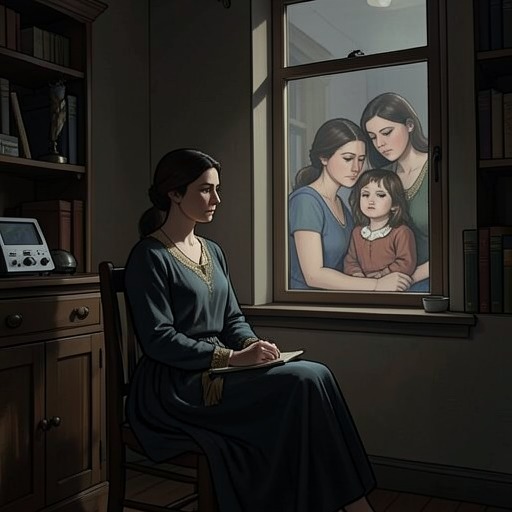
el vínculo entre madre e hija
También esto pasaráel vínculo entre madre e hija is the emotional point of reference around which Blanca’s grief and memories gather. It is neither uncomplicated confidence nor a tie severed by death: her mother’s love could feel unreliable, yet her gaze gave Blanca a sense of belonging that she had never thought to question. After her mother dies, ordinary habits, remembered scenes, and even an imagined meeting at the cemetery keep the relationship active in a changed form.
Intimacy and its boundaries
Blanca and her mother were not confidantes who told each other everything, and Blanca does not describe them as friends. Each tried to appear presentable to the other. The boundary was plain in an adolescent memory: when her mother worried that Blanca’s period had not begun, Blanca calmly told her it had begun two years earlier and that she had not shared the fact because it was none of her mother’s business. Her mother stopped the car in astonishment, then drove on as other drivers honked; neither raised the subject again. Their closeness therefore did not depend on complete disclosure.
Blanca also kept her romantic life apart from her mother. From a young age, she instinctively protected that part of herself, fearing that her mother’s forceful mixture of selfishness, generosity, clear-sightedness, and love would occupy it too. Her mother watched her fall in and out of love, suffer, and recover from a respectful distance, taking pleasure in Blanca’s happiness without directing her through it. Blanca understands this restraint as part of the bond, not evidence of indifference: she believes her mother knew that their love was already the central one in her life, and that its presence informed the loves that followed, including her fierce love for her children.
A bond that gives Blanca her place
The mother’s importance appears most starkly in Blanca’s account of being loved. After the death, people repeatedly assure her that many people care for her. She appreciates the reassurance but cannot make it substitute for what she wants: her mother beside her, holding her hand and placing a hand on her forehead. She admits that she no longer trusts anyone’s love in the same way, partly because there was a time when even her mother seemed to stop loving her. The bond is foundational, but not idealized as endlessly secure.
Her mother’s gaze had given Blanca an unquestioned place in the world. Blanca says she never bothered to find out where that place was because it seemed so permanent. At forty, with two children, two marriages, other relationships, homes, and jobs behind her, she feels she must now make the transition from being a child to adulthood without her mother’s eyes upon her. Orphanhood is not simply a status: it is the loss of the person whose way of looking made Blanca feel located and known.
Shared life, memory, and care
The family home in Cadaqués holds the bond in accumulated scenes. Blanca remembers her grandfather arriving with fruit from Barcelona, long breakfasts, beach towels drying on the railing, reluctant siestas, ice creams, and card games. The same house contains the first drinking, loves, dawns, and the conception of Blanca’s first child, followed by visits with children, separations, and her mother’s old age. Its routines changed little even as happiness changed, the doors began to close, and the house grew old alongside its owner. Memory does not preserve one fixed version of mother and daughter; it brings a whole shared life, from childhood summers to the mother’s decline, into the present.
Care also appears through people and animals connected to the household. After the children return from Guillem’s home with vegetables from his garden, Blanca recalls the mother who welcomed and enlarged the lives of those she loved. Guillem had taken in Patum, the dog once shared with Blanca, and brought her to the mother’s funeral wearing a black ribbon. Earlier, the mother had accepted that Patum could no longer stay with her. Blanca understood that relinquishment as a sign of how close the end had become. Later, alone with Patum, Blanca watches the dog wait at the mother’s bedroom door and sniff through the house for her scent. The dog’s searching echoes Blanca’s own inability to stop looking for signs of return.
Grief in the body and in the everyday
After her mother’s death, Blanca finds brief relief in physical contact. During a pedicure in the village, the esthetician massages her feet; Blanca says that even fleeting or casual touch is a comfort. Books, which might once have consoled her, now lead too directly back to her mother: to the shelves at home, the annual cleaning of the library, and trips to London to find illustrated books. She remembers examining them together on a hotel bed, her mother absorbed in the pages. The mother’s habits remain vivid, but their former objects of shared pleasure have become charged with absence.
This grief does not proceed in a straight line. Sex with Óscar briefly seems to dispel both death and life, but the relief lasts only moments or, if sleep follows, a little longer; the room, memories, panic, and sorrow return to their places. Later, at a party’s end, Blanca leaves before dawn and turns away from the beach toward the cemetery at Port Lligat. She has imagined arriving there alone, composed and healed. Instead, the gate is locked. She pushes and pounds on it until her hands hurt, then sits exhausted as morning comes. Her failed attempt to reach her mother’s grave makes the separation tangible, while the familiar light and the view toward the harbor draw her into memory.
An altered presence
From the cemetery wall, Blanca sees her mother walking along the quay toward her boat, in a faded checked shirt over her swimsuit and accompanied by her dogs. The scene gives the absent mother a particular, remembered body and movement; before boarding, she turns, smiles, and reassures Blanca that this will pass too. The encounter does not erase the locked gate or establish that grief is over. Instead, it gives the remembered voice a place within the ongoing loss.
That continued bond enters ordinary life as well. When Blanca drives past her mother’s former apartment on Carrer de Muntaner, she notices her older child silently looking up at the balcony. She cannot honestly tell him that his grandmother is in a better place, because she knows how much the mother loved being with her grandchildren and Blanca. Blanca is beginning to breathe more easily and has fewer nightmares, though the sense of her mother’s vitality returns only on some days. She takes her mother’s jacket to the dry cleaner, where it is promised back as good as new. The practical errand does not restore the person; it carries her presence forward through an object that can still be cared for.